Interview #8 with Kirk Hawkins. Caracas Burns: Post-Chavismo and Populism  

You the people are the giant that awoke, I your humble soldier will only do what you say. I am at your orders to continue clearing the way to the greater Fatherland. Because you are not going to reelect Chávez really, you are going to reelect yourselves; the people will reelect the people. Chávez is nothing but an instrument of the people.

Hugo Chávez

Kirk Hawkins

Kirk Hawkins

POP interviews prof. Kirk Hawkins. He is the coordinator of Team Populism, a cross-regional scholarly network that studies the causes of populism. He published Venezuela’s Chavismo and Populism in Comparative Perspective (2010, Cambridge University Press). He is currently editing a volume that presents Team Populism’s latest work. 

In this interview prof. Hawkins analyses the Venezuelan case from a ‘populist perspective’, answering questions about the links between Maduro and Chavez, their populist discourses, and the future of Venezuelan democracy. Continue reading →

Latvia Pop: Three Cases of post-Soviet Populism

to whom belongs the state

Who owns the State? is the new populist actor in Latvia.

Like a salmon swimming upstream, while scholars on populism debate about Brexit, the Spanish elections, the Icelandic new President, and Italian local elections, POP presents an article written by Ilze Balcere about the story of populist movements in Post-Soviet Latvia. Although they have been mainly short-lived and ephemeral experiences, a couple of populist parties made it to the national parliament (Saeima). Ilze Balcere traces the evolution of populism in Latvia in the last 20 years and claims that  in her country populism does not seem to be a particularly successful political strategy, but this might change in the future. Continue reading →

Interview #7 – A talk with Cas Mudde on American and European Populism

trump tower.jpg

Trump Tower in Chicago – April 2016

POP interviewed Prof. Cas Mudde about populism in the US and Europe, the presence (or rather absence) of populism in the current American Presidential campaign, and the conditions triggering different types of populism in the Old continent.

Are “the people” and “the elites” relevant categories in the discourses articulated by Trump and Sanders?

The economic crisis, combined with terrorist threats and a constant flow of migrants create a widespread fear among the European electorate: which political actors benefit from this situation?

These and other issues on the interview with Prof. Mudde.

Enjoy…

Continue reading →

To break, or not to break? Brexit and the future of the UK’s relationship with Europe #2

This is the second part of Laura MacKenzie’s article about Brexit. In the first episode she presented the two opposing factions and the key political figures. Today she analyses the key arguments of the leave and remain campaigns. In the meantime, former London mayor Boris Johnson declared that the EU – as well as Hitler and Napoleon – is trying to unify Europe under a superstate and to bring it back to the golden age of the Romans.

Continue reading →

To break, or not to break? That is the question #1

Politics is ultimately a numbers game, and the figures just don’t add up [1]

On 23 June, British voters will go to the polls to solve a very large maths problem.  The United Kingdom is currently in a battle over its identity as a European nation, and both sides of the debate are clamouring for attention and support.  However, no matter how convincing the arguments; no matter how witty the speeches; no matter which celebrities sign up to which campaign; the ‘Brexit’ battle will, ultimately, be won on numbers.

When faced with the question on the ballot paper, “should the United Kingdom remain a member of the European Union or leave the European Union?” voters will respond by asking their own question:  do the figures add up?

Continue reading →

Donald Trump: the Perfect President for the Divided States of Europe?

On March 13th the elections in three German regions brought once again on the table a fundamental question about Europe: will we be able to overcome our fears and open our political-economic project also to those that so far have been excluded? Or will we rather entrench ourselves in our fortress?

It is time to define our collective identity. And it is time to consider that the way we are doing it now will be marked in history books as one of the biggest European shames.

In other words: let’s imagine that we have to elect a supreme leader for Europe in 2017. Let’s assume Donald Trump would participate. Would he win the elections? Continue reading →

Why Scandals are vital in Populist Communication

shengen nein

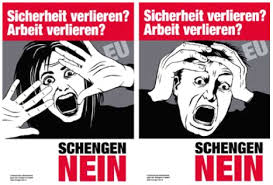
SVP poster against Schengen, 2006. Security and freedom would get lost if Switzerland remains in the Schengen area.

Today Dr. André Haller explores a peculiar populist communication strategy: self-scandalization. While he keeps updating POP about the controversial positions of the anti-Muslim group PEGIDA, he also explains us how populist parties and movement create, exploits and take advantage of manufactured political scandals.

Continue reading →

Re-Branding Right-Wing Politics #2 – FPÖ between ‘good’ and ‘bad’ Serbian migrants

2946275125_fcdb18bdbc_b

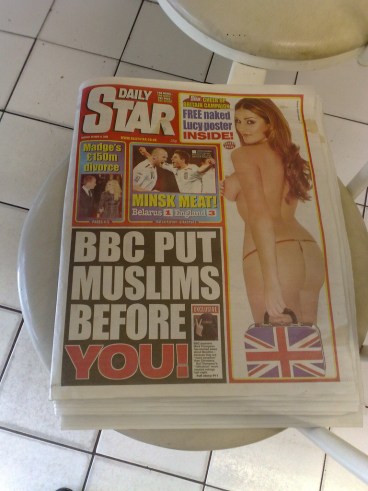
Daily Star. October 2008.

(See here the first part of the reportage. Happy new year and enjoy the first POP’s article in 2016. The schedule for the next months is pretty dense; we will take you into the very heart of contemporary populism. Follow POP on #Twitter and spread the word!).

Serbians as Well-Integrated Model Migrants

An anti-immigration party longing for migrants’ votes might sound contradictory to many, but this ‘search’ is an extension of the rhetoric of good and bad foreigners. A closer look at FPÖ’s position on Balkan politics makes this strange alliance between an anti-immigration party and Serbian migrants a little clearer. The current situation of the Balkans is an indicator of the multicultural fantasy, as its official party program writes, that descends from EU politics, whose capital infusion and political support for the central government of Bosnia-Herzegovina promote further Islamization of the Balkans. The geopolitical importance of Serbia, here, consists in its role as a buffer state between Central Europe and the Southern Balkan Peninsula; the border between Christendom and Islam. In the eyes of the ‘Freedomite’ politics, Serbia, the vanguard of the Occident in the conflict-ridden Balkans, is an example of the tragic failure of multiculturalism propagated by the European Union. Continue reading →

Re-Branding Right-Wing Politics: The Freedom Party of Austria and their Serbian Migrant Supporters

Byeongsun Ahn

Byeongsung Ahn

This article, written by Byeongsun Ahn, PhD Student at the Department of Sociology of the University of Vienna, focuses on a paradoxical element of contemporary populism: the distinction between “good” and “bad” migrants. In particular, Byeongsun Ahn exposes the Austrian case, and explains why FPÖ politicians now make frequent appearances in Serbian restaurants and nightclubs, where they pose in front of Ćevapčići and dance Turbo-Folk. This is the first half of Ahn’s reportage.

Continue reading →

“The worst intellectual instigator since Goebbels!”

André Haller

Dr. André Haller

This is the first article of a series about PEGIDA’s controversial messages. It is written by Dr. André Haller, who works at the Institute for Communication Science at University of Bamberg, Germany.

He will follow for POP the activities and communication strategies of PEGIDA. For an overview about the Patriotic Europeans Against the Islamisation of the Occident, see his article published in November 2015. Continue reading →