Interview #65 – AfD and the end of German Exceptionalism

Germany has long been viewed as *the* model for reckoning with past atrocities—particularly through its atonement for the Holocaust and the creation of a public space steeped in historical reflection and contrition. Unlike Italy, for example, Germany has made its national memory a central pillar of its identity. However, this commitment to remembrance is now producing some unforeseen challenges.

For example, the legacy of the Holocaust makes critical public discussions about the actions of the Israeli government very difficult. At the same time, antisemitism, which has never fully disappeared, is once again on the rise.

In November 2023, members of the far-right party AfD were caught in a secret meeting discussing a “master plan” for the mass deportation of foreigners and “non-assimilated” Germans. When the news broke in January 2024, over a million people took to the streets across Germany to protest extremism and AfD’s ideology.

While the widespread mobilization in defense of democracy is heartening, it’s equally concerning that a party like AfD—which would have been considered taboo just a decade ago—has not only gained traction but may even be poised for government in the near future.

So, how did AfD become the third-largest political force in Germany? And is the country’s democratic cordon sanitaire strong enough to hold?

This interview delves into these questions and more with political expert Manès Weisskircher.

Enjoy the read.

Continue reading

Migration, walls and populism in Bulgaria

In this article Ildiko Otova and Evelina Staykova present their new book ‘Migration and Populism in Bulgaria’, published by Routledge. They descrbe how Bulgaria was unprepared for the arrival of migrants and asylum seekers in 2015, and how this phenomenon produced a sense of emergency that was exploited by populist actors. The populist rhetoric about the ‘migrants crisis’ of 2015 became so widespread that also non-populist actors started framing the topic in the same way. This produced a normalisation of right-wing, authoritarian, and populist discourses. Fear and scapegoating were used to generate a ‘crisis’ that has exacerbated popular dissatisfaction with the country’s institutions. In this context, real solutions and effective policies remained a mirage. Apart from walls, obviously, which are an all-time favourite and an instinctive response of authoritarian populists. In July 2021, the European Court of Human Rights ruled that Bulgaria’s pushback practice violates human rights, and in August, amid growing concern in Europe over an influx of migrants from Afghanistan, Bulgaria decided once again to bolster its border with Greece and Turkey with hundreds of soldiers.

Ildiko Otova and Evelina Staykova tell us how we got here…

Continue reading

Interview #35 — Notes from the third nationalist wave

In this interview, Sivamohan Valluvan explores the current wave of nationalism. Valluvan argues that Trump, Bolsonaro and Orban capitalized on the mainstreaming of nationalist ideas that started with moderate predecessors declaring the ‘death of multiculturalism’ such as Sarkozy, Merkel and Cameron. We then explore many topics and examine a variety of examples, including Brexit, authoritarian populism, Denmark, Thatcherism, and common misunderstandings about the links between working-class and nationalism.

His new book, “The Clamour of Nationalism” is an excellent read, and lately it has been mentioned in a very interesting article concerning the debate on how Europe intends  to “protect the European way of life”.

Enjoy the read.

Continue reading

Gender as a Rhetorical Tool for Strengthening Illiberal Democracy in Hungary

In this article, Bianka Vida explains how the Hungarian government uses gender as a rhetorical tool to strengthen its illiberal regime. The so-called “gender theory” is a threat to any right-wing populist government, including Fidesz in Hungary. Starting from the Hungarian example, Vida illustrates how gender is exploited by right-wing political parties to expand illiberal democracy. What is the role of the EU in this illiberal transformation, and what will be the future of Universities proposing courses on gender studies?

Continue reading

The 5 Star Movement is neither left-wing nor antifascist

I know that the right-left political spectrum is slippery. Most people consider it dead and buried. End of history, post-ideological world, and whatnot.

I know that when a politician tells you “we are neither right nor left, just #populist” it gets even more confusing .

I know the face people make when I say that (on the cultural dimension and therefore by synecdoche) the 5 Star Movement is a right-wing partyContinue reading

Interview #7 – A talk with Cas Mudde on American and European Populism

trump tower.jpg

Trump Tower in Chicago – April 2016

POP interviewed Prof. Cas Mudde about populism in the US and Europe, the presence (or rather absence) of populism in the current American Presidential campaign, and the conditions triggering different types of populism in the Old continent.

Are “the people” and “the elites” relevant categories in the discourses articulated by Trump and Sanders?

The economic crisis, combined with terrorist threats and a constant flow of migrants create a widespread fear among the European electorate: which political actors benefit from this situation?

These and other issues on the interview with Prof. Mudde.

Enjoy…

Continue reading

To break, or not to break? Brexit and the future of the UK’s relationship with Europe #2

This is the second part of Laura MacKenzie’s article about Brexit. In the first episode she presented the two opposing factions and the key political figures. Today she analyses the key arguments of the leave and remain campaigns. In the meantime, former London mayor Boris Johnson declared that the EU – as well as Hitler and Napoleon – is trying to unify Europe under a superstate and to bring it back to the golden age of the Romans.

Continue reading

To break, or not to break? That is the question #1

Politics is ultimately a numbers game, and the figures just don’t add up [1]

On 23 June, British voters will go to the polls to solve a very large maths problem.  The United Kingdom is currently in a battle over its identity as a European nation, and both sides of the debate are clamouring for attention and support.  However, no matter how convincing the arguments; no matter how witty the speeches; no matter which celebrities sign up to which campaign; the ‘Brexit’ battle will, ultimately, be won on numbers.

When faced with the question on the ballot paper, “should the United Kingdom remain a member of the European Union or leave the European Union?” voters will respond by asking their own question:  do the figures add up?

Continue reading

Donald Trump: the Perfect President for the Divided States of Europe?

On March 13th the elections in three German regions brought once again on the table a fundamental question about Europe: will we be able to overcome our fears and open our political-economic project also to those that so far have been excluded? Or will we rather entrench ourselves in our fortress?

It is time to define our collective identity. And it is time to consider that the way we are doing it now will be marked in history books as one of the biggest European shames.

In other words: let’s imagine that we have to elect a supreme leader for Europe in 2017. Let’s assume Donald Trump would participate. Would he win the elections? Continue reading

Why Scandals are vital in Populist Communication

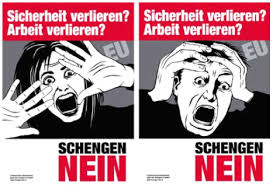
shengen nein

SVP poster against Schengen, 2006. Security and freedom would get lost if Switzerland remains in the Schengen area.

Today Dr. André Haller explores a peculiar populist communication strategy: self-scandalization. While he keeps updating POP about the controversial positions of the anti-Muslim group PEGIDA, he also explains us how populist parties and movement create, exploits and take advantage of manufactured political scandals.

Continue reading