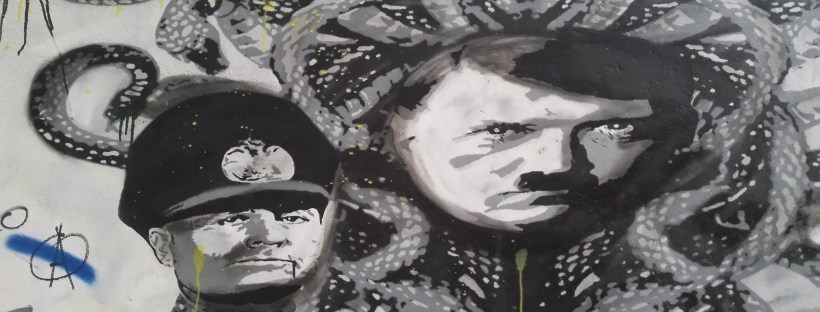
Interview #65 – AfD and the end of German Exceptionalism

Germany has long been viewed as *the* model for reckoning with past atrocities—particularly through its atonement for the Holocaust and the creation of a public space steeped in historical reflection and contrition. Unlike Italy, for example, Germany has made its national memory a central pillar of its identity. However, this commitment to remembrance is now producing some unforeseen challenges.

For example, the legacy of the Holocaust makes critical public discussions about the actions of the Israeli government very difficult. At the same time, antisemitism, which has never fully disappeared, is once again on the rise.

In November 2023, members of the far-right party AfD were caught in a secret meeting discussing a “master plan” for the mass deportation of foreigners and “non-assimilated” Germans. When the news broke in January 2024, over a million people took to the streets across Germany to protest extremism and AfD’s ideology.

While the widespread mobilization in defense of democracy is heartening, it’s equally concerning that a party like AfD—which would have been considered taboo just a decade ago—has not only gained traction but may even be poised for government in the near future.

So, how did AfD become the third-largest political force in Germany? And is the country’s democratic cordon sanitaire strong enough to hold?

This interview delves into these questions and more with political expert Manès Weisskircher.

Enjoy the read.

Continue reading

Interview #49 — Dealing with the past and the politics of memory

In this interview, Geneviève Zubrzycki explains how invented traditions constitute a pillar of modern nations and therefore how collective memories can help us understand modern nationalism. Memory is utterly political, she told POP, since it gives an explanation to collective questions about identity, who we are are where do we go.

From there, we discuss the universalization of the Holocaust and the German process of Vergangenheitsbewältigung, the Polish case and the efforts of Law and Justice to remythologize collective memories through a paradigm of victimhood. We then analyze the concept of “Christian heritage” and its implications, and discuss how the election of Donald Trump and the Black Lives Matter movement reopened in the US a discussion about the legacy of slavery and reparations, the meaning of the Confederacy and its symbols in the South.

Enjoy the read.

Continue reading

The Fall and Rise of AfD: Windows of Opportunity and Political Culture

Dr. André Haller analyses the ideological evolution of Alternative for Germany (AfD) and its communicative strategy, the role played by the so called ‘refugees crisis’, and the possibility for right-wing populism to finally thrive in Germany, immune to right-wing populist Pied Pipers since the aftermath of World War II.


Continue reading

#HenrietteReker – Something is rotting in Germany (and we are not talking about Volkswagen)

Election Poster 2015

Election Poster 2015

Saturday 18th October 2015, Henriette Reker – a mayor-candidate of Cologne – was stabbed several times during a pre-election party. Reker was not only an independent – yet very promising – candidate but she also used to be in charge of the local accommodation of refugees in Cologne. Even though she and four other persons got severely injured, she won the election the next day.

So what’s the story behind the attack? The offender claims Reker’s refugee policy to be the cause: “By killing her, I wanted to do Germany a favor”. Now we know that his motives were xenophobic, and that he was connected to a – nowadays forbidden – right-wing extremist organization called Liberal German Worker’s Party[1].

An attempted murder motivated by someone’s refugee policy must be a meaningful wake-up call for Germany. So far, this gesture remained an isolated incident. However it is very important to ask: how did we come to this? Continue reading