
Populism isn’t just another political buzzword (well, it’s also that…)—but it is an important tool to understand today’s world, if used correctly. The problem? Everyone talks about populism, but few can actually pin down what it is. Is it a dangerous threat to democracy—or a much-needed wake-up call? Is it ideology, performance, strategy… or all of the above? Who counts as “the people,” and who are “the elites”?
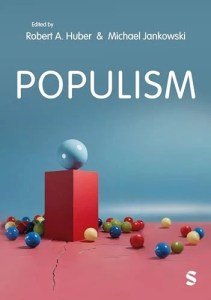
Enter Populism: An Introduction. This isn’t another academic doorstop—it’s an accessible guide that cuts through the noise. Written by leading scholars but crafted for students, readers, and anyone curious about the forces reshaping our world, it connects big theories with real-world politics in a way that finally clicks. If you’ve ever wanted to go beyond the headlines and actually understand how populism works—and why it matters right now—this is the book.
Professors everywhere are being asked to explain what it is, why it matters, and how it’s reshaping politics across the globe. The problem? Most readings are either too dense, too narrow, or too disconnected from what students actually want to learn. That’s why Populism: An Introduction is such a game-changer. Finally, a resource that makes teaching populism not just possible, but exciting. It reminds me in more than a way of my own The Populism Interviews, but with a different approach.
And now, the editors themselves explain how they pulled it off.
Enjoy the read!
You might know this situation: the dean asks you to submit your teaching ideas for the upcoming semester. Maybe they want you to teach something new—keep things fresh, you know? So, you start brainstorming. Of course, you want to teach something relevant. Maybe a course on electoral systems? But students often don’t find that especially exciting. How about party politics? Probably too broad, and chances are your more senior colleagues have already claimed that slot.
What you really want is to teach something that’s not only relevant in political science research but also in high demand among students. So—why not a course on populism?
That sounds perfect. Few political phenomena have been discussed as intensively in recent years. Donald Trump’s presidency only fuelled more interest, and [insert a well-known populist from your country] has stirred debate too. There’s also plenty of cutting-edge research on the topic—and students are genuinely interested.
So, a course on populism it is!
But where do you start? You can’t assume students are already familiar with the nuanced academic debates: Is populism a “thin-centred” ideology (whatever that means!), a discourse, a style, a strategy—or something else entirely? Can populism even be measured empirically? If so, how?
There are countless articles addressing these questions, with new ones published every month (or day). There are handbooks, too—but they’re not always student-friendly. We’d heard these calls for accessible readings from colleagues so many times. That was our starting point when we began working on a textbook on populism in 2023.
Building the Book
When you’re new to populism research, getting a solid grasp on both the fundamentals and the current debates can be tough. That’s why, in 2023, we decided to create a textbook that focuses on the empirical study of populism, aimed at students and anyone unfamiliar with the field. We reached out to SAGE with our idea. The book should serve as an accessible guide to core themes in populism research, even if you haven’t studied political science for years.
We then contacted several internationally recognized scholars to contribute. The response was overwhelmingly positive. And at the beginning of 2025, we’re thrilled to hold the final product in our hands: Populism: An Introduction.
What’s in the Book?
Yes, it’s an introductory textbook. But what can you—or your students—actually expect from it?
The book is divided into three main parts, reflecting our core philosophy: connecting theory and empirics through methods.
- Theoretical Foundations – introducing core concepts and approaches to populism.
- Methodological Approaches – outlining ways to empirically study populism.
- Key Issues in Populism Research – exploring essential topics like communication, party competition, and representation.
We hope these fifteen chapters together offer a comprehensive, accessible, and engaging introduction to the world of populism.
Below, Brazilian populism (2025). The elites and the people. On the left: Zé Pelintra, patron of bars, games and bohemian life. On the right: Juscelino Kubitschek, former president.


A Chapter-by-Chapter Overview
Chapter 1 offers a general introduction to populism research. We show how it has long been a political science topic, but interest has surged in recent decades—especially since Donald Trump’s election. We also outline the book’s structure here.
Chapter 2, by Luca Manucci (yep, that’s me), gives a clear and engaging overview of the history of populism research. It explains how theories have evolved in response to how populism appears across different regions—what works in Latin America, for instance, might not in Western Europe.
Chapter 3, by Sofia Vasilopoulou and Daphne Halikiopoulou, tackles the classic “what is populism?” question. They explain three common perspectives: populism as an ideology, as a style, and as an organizational logic. Each has distinct research implications and methodological approaches.
Chapter 4—by Saskia Ruth-Lovell, Rosa Kindt, Joep van Lit, and Marie-Isabel Theuwis—looks at populism’s effects on democracy. Populists often challenge democratic norms, but they can also reinvigorate democracy. The chapter explores when populism acts as a threat or as a corrective force.
Chapter 5, written by Michael and Robert (that’s us, the editors), examines how populism relates to other ideologies. We show how populists define “the people” and “the elite” often depends on their underlying ideology—like nativism in radical-right populism. We also discuss “valence populists,” who lack a clear ideological agenda.
Chapter 6, by Alexander Alexseev and Emilia Palonen, introduces qualitative approaches to studying populism. It focuses on discourse: the Wodakian approach examines context-specific language use, while the Laclaudian approach studies how leaders create collective identities and political meaning.
Chapter 7, by Nina Wiesehomeier and Maurits Meijers, explores expert surveys in studying populist parties. They walk through projects like POPPA and PREPPS, discussing challenges in defining and measuring populism and the trade-offs of different survey designs.
Chapter 8, by Lisa Zehnter, breaks down how to study populism using text-as-data. She explains hand-coding, dictionary methods, and machine learning in a way that’s accessible to students, with real-world examples like election manifestos.
Chapter 9, by Bruno Castanho Silva, discusses how researchers have used public opinion surveys to measure populist attitudes among citizens. It shows the four most commonly used scales to exemplify different issues and decisions that scholars make, and explains how populist are people across the world.
Chapter 10, by Edina Strikovic and Linda Bos, focuses on populist communication—how rhetoric and media are used to connect with “the people.” It shows that communication is central to how populist ideas are expressed and spread.
Chapter 11, by Patricia Rehus and Steven Van Hauwaert, investigates who supports populists and why. They show there’s no one “typical” populist voter, but many share strong populist attitudes and a sense that democracy isn’t working as it should.
Chapter 12, by Sofia Marini and Markus Wagner, looks at how populist parties affect party competition. They explore how mainstream parties react—ignore, adapt, or adopt—and assess the effectiveness of exclusion strategies like the cordon sanitaire.
Chapter 13, by Fred Paxton, examines populists in government. What happens when movements built on opposition suddenly find themselves in power? Drawing on examples from Europe, Latin America, and the U.S., the chapter looks at how populists govern—and the consequences for democratic quality.
Chapter 14, by Christina-Marie Juen, explores populism’s impact on political representation. She focuses on descriptive and substantive representation and shows how populist parties vary in their approaches—especially between radical-left and radical-right actors.
Chapter 15 wraps up the book by summarizing key insights and outlining open questions. Populism is a global phenomenon, but it takes different forms across regions. This chapter lets us reflect on the process—and share our outlook with readers.
Who’s the Book For?
This book is designed for students in the social sciences—but also for anyone curious about populism: its definitions, causes, and consequences. Whether you’re studying political science, sociology, or simply trying to understand today’s political shifts, Populism: An Introduction gives you the tools to engage critically and analytically with populism.
It’s also a valuable resource for more advanced readers—especially if you’re well-versed in theory but want a primer on empirical methods. Part 2 is especially useful here.
Unlike most academic articles or handbooks, we’ve worked hard to ensure this book is accessible to beginners. Case studies, discussion questions, and recommended readings support that goal.
What’s Next?
Putting this book together was a lot of work—but also incredibly rewarding. We’re very proud of the result and already have ideas for a second edition. If you have feedback or suggestions, we’d love to hear from you—please get in touch!

Michael Jankowski works as Manager at an international consulting firm. Previously, he was Team Lead for Data Science and AI in the Federal German Chancellery. Between 2014 and 2023 he was a researcher in political science focusing on political behavior, comparative politics and quantitative methods.

Robert A. Huber is a Professor of Political Science Methods at the Department of Political Science at the University of Salzburg. Robert’s primary research focus revolves around examining how globalisation poses new challenges to liberal democracy. Robert is an editor at the European Journal of Political Research.

 POP
POP 