
Populism has been one of the most debated topics in contemporary political science, drawing waves of scholarly attention after major global events. In particular, the dual shocks of Brexit and Donald Trump’s election in 2016 cemented populism as a central topic of political analysis—often leading to its use as a buzzword rather than a useful tool for understanding the world we live in. The explosion of academic research, resulting in numerous books, journal articles, and dedicated scholarly journals, hasn’t always seemed necessary, to say the least. This raises the question: do we need yet another handbook on populism?
The recent publication of the Research Handbook on Populism, edited by Yannis Stavrakakis and Giorgos Katsambekis, demonstrates that the academic field continues to evolve. This handbook seeks to provide a comprehensive and theoretically nuanced examination of populism, incorporating various perspectives and disciplinary approaches. It covers the four dominant frameworks in populism studies—the ideational, discourse-theoretical, strategic, and socio-cultural approaches—while also integrating historical analyses and contributions from diverse academic fields such as political economy, international relations, and psychoanalysis.
This article, written by Antonis Galanopoulos, explores the significance of this new handbook within the broader landscape of populism studies, assessing the unique contributions of the handbook, its methodological pluralism, and its efforts to address gaps in existing literature. Furthermore, it critically examines its strengths and potential limitations, considering how it shapes future research directions in the study of populism.
And to fill the gap identified by Antonis, namely the lack of a guide on how to navigate the chaos created by the recent populism boom and consequent hype, well…there are always The Populism Interviews for that 😉
Enjoy the read…
Populism research and literature experienced a prolonged boom in the early 21st century. Renewed interest in the concept of populism was initially sparked by the 2008 financial crisis, its impact on the global economy—particularly in Southern Europe—and the resistance that emerged against the crisis’s effects and the austerity measures adopted to tackle it.
The second cycle of heightened attention followed the dual shock of 2016: Brexit and Donald Trump’s victory in the U.S. presidential election. During this period, many academic papers and articles were published, hundreds of books were released, and three academic journals devoted to populism were established.
Between 2017 and 2021, three major academic handbooks on populism were published by reputable academic publishers, practically one a year. Populism is often described in academic texts as an essentially contested concept. These handbooks aimed to bring order to the fragmented field of populism studies, characterized by a multitude of definitions and approaches. Their goal was to classify different approaches and analyses and highlight key topics and issues of interest to populism scholars.
Since 2022 voices proclaiming the end of the populist moment or the emergence of a post-populist era have multiplied. Yet, a new handbook has appeared just a few months ago. What does this latest volume, published just a few years after the earlier ones, have to offer to the populism literature?
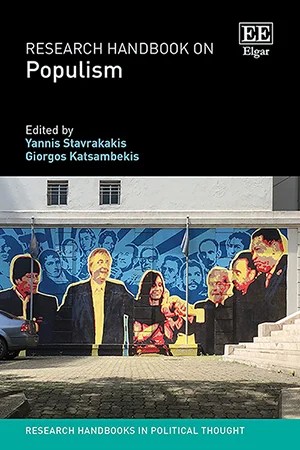
The Research Handbook on Populism, edited by Yannis Stavrakakis and Giorgos Katsambekis, stands out for its effort to provide a comprehensive and theoretically nuanced exploration of the phenomenon. In my view, it is the most theoretically complete handbook on populism to date. The editors, both prominent figures in the discourse-theoretical approach to populism, aim to offer a balanced and systematic treatment of the concept.
The volume covers the four primary approaches in the field:
Socio-cultural, which examines populism as a political style or a set of cultural practices, highlighting extra-discursive elements such as accent, gestures, and body language.
Ideational, which defines populism as a thin-centered ideology that views society as divided between “the pure people” and “the corrupt elite.”
Discourse-theoretical, which sees populism as a political logic that constructs and articulates the division between the people and the elites through discourse.
Strategic, which understands populism as a political strategy used by opportunistic leaders to mobilize supporters and consolidate power.
Additionally, it incorporates significant contributions from intellectuals such as Richard Hofstadter and Margaret Canovan, laying a historical foundation for contemporary analysis. The focus on Hofstadter is particularly crucial, as his work serves as the foundation of the diachronic academic anti-populist canon.
The Research Handbook on Populism is fair to all approaches, which is not always the case. For instance, one earlier handbook omitted the discourse-theoretical approach as a distinct and fundamental theory, while another disregarded the socio-cultural perspective. Notably, Cas Mudde (2017, in Kaltwasser et al., 2017) attempted to justify the absence of the discourse-theoretical approach as a distinct approach in the Oxford Handbook of Populism by incorporating it into the broader ideational framework—a highly debatable move.
The Routledge Handbook of Global Populism, while recognizing the discourse-theoretical approach as one of the three major contemporary theories of populism, adopts from the outset a critical stance toward it. While such critique is perfectly legitimate, it stands in contrast to the presentations of the ideological and politico-strategic approaches in the same volume. Stavrakakis and Katsambekis’s handbook “restores” the discourse-theoretical perspective, situating it alongside the other key approaches. In this context, Thomassen’s chapter, “Ernesto Laclau, Chantal Mouffe, and the Discursive Approach,” offers an in-depth engagement with the discourse-theoretical perspective, incorporating both theoretical analysis and empirical observations. Through this discussion, Thomassen critically assesses both the strengths and limitations of this approach to populism.
Another notable feature of this handbook is its multidisciplinary scope, what the editors called in the introduction “methodological pluralism and epistemological cross-fertilization” (p. 3). Contributions from various disciplines form a vibrant mosaic of insights into the nature and dynamics of populism. Beyond the usual suspects—political science, sociology, and history—the volume includes perspectives from political economy (Tunderman), international relations (Chryssogelos), law (Kaidatzis), communication studies (Hatakka), and psychoanalysis (Zicman de Barros), among others.
Diversity is a guiding principle of the Research Handbook on Populism and this decision of the editors deserves praise. This diversity is clear in the structure of the volume, the choice of topics, and even the selection of the contributors. Beyond its emphasis on the main theories of populism, the handbook features thought-provoking sections on the historical roots of populism, typologies, research agendas across different disciplines, and an empirical part with case studies.
The second part, titled “Diachronies,” is a key contribution to the existing literature. All six chapters prove that populism is neither a contemporary nor a marginal phenomenon. It has historical depth that can be traced back centuries, and it is not a political phenomenon exclusive to underdeveloped countries. Characteristically, recent scholarship highlights that the birthplace of contemporary populism is actually the United States (see Frank, 2020), a perspective reinforced by Charles Postel’s chapter in this volume. Additionally, Biglieri’s chapter on Argentina is highly informative, both regarding populism and Peronism, clarifying common misconceptions and explaining the persistence of various Peronist currents in the country to this day.
The section “Hotspots of Populism” (Part VII) further demonstrates the global nature of the populist phenomenon. By examining case studies from different regions, from Latin America and Europe to Southeast Asia and Africa, the volume illustrates how populism manifests in diverse socio-political contexts. This empirical grounding strengthens the theoretical discussions while also breaking away from the Eurocentrism that characterizes much of the recent literature on populism, as well as research in social and political sciences more broadly.

As mentioned above, the volume presents certain novelties regarding the topic selection. Nationalism, communication strategies, leadership, and the relationship between populism and democracy are fundamental topics in the field and are discussed here in more sophisticated ways than usually. A particularly telling example is the contribution of Mazzarella (Chapter 24) on the role of charisma and the idea of participatory enjoyment. At the same time, the handbook brings under-researched themes and topics, which often remain outside the mainstream of populism studies—into focus. The final part, “Research Challenges”, includes chapters devoted to feminism (Cadahia), religion (Papastathis), the commons (Kioupkiolis), and colonialism (Filc), broadening the perspective of anyone interested in the debate around populism.
Moreover, the editors also seem to have strived for diversity among the group of contributors. Significant research decisions represent not only epistemological and intellectual choices but also ethical commitments. In other words, they reflect a certain research ethos that takes into account the need to limit inequalities within academia. Notably, approximately one-third of the contributors are junior scholars, and approximately one-third are female scholars. The field of populism studies, as a scholarly community, needs to persistently address such inequalities and challenge explicit or implicit hierarchies.
Of course, no single book or handbook can cover every possible aspect of a given topic. Despite its strengths, I would like to highlight two potential shortcomings of the Research Handbook on Populism.
First, methodological pluralism. Except for Chapter 28 on surveys, references to methodological issues are rather indirect and dispersed throughout the chapters. A dedicated section discussing different ways to analyze populism would have been a welcome addition, reinforcing the handbook’s empirical dimension, offering useful insights and practical guidance to students and emerging scholars.
Secondly, navigating the populism boom. Although the volume includes nine chapters on research challenges, readers would have benefited from a guide on how to navigate the chaos created by the recent populism boom and move “beyond the populist hype”—a topic only briefly discussed in Chapter 44. The idea of a coda summarizing the state of the field and future research directions would have been particularly useful for younger scholars who feel uncertain about entering and navigating a field perceived as narrow or in decline.
Overall, in my view, the Research Handbook on Populism brings a fresh wind of originality to the field. It is particularly relevant in light of ongoing debates on the nature of populism and its relationship with democracy. By offering a theoretically complete and multidisciplinary exploration of populism, it challenges stereotypical and normative understandings of the phenomenon, reinvigorates research interest, and expands the scope of academic investigation on the topic of populism.

Antonis Galanopoulos holds a PhD in Political Sciences from Aristotle University of Thessaloniki (AUTh) and is a Project Coordinator at the Eteron – Institute for Research and Social Change. His research interests include discourse theory, psychosocial studies, (anti)populism, nationalism, and democracy. He is on Substack.

 POP
POP 