
What are anti-establishment parties, and what do they have to do with populism? Can they also be technocratic? How have they been evolving over time? Are all parties equally credible when they produce a political message against the status quo? Can ‘normal’ parties become populist? We discuss all these issues – but also the evolution of the German AfD, Margaret Canovan, and the populist Zeitgeist – in this interview with Bartek Pytlas.
Enjoy the read.
1) Bartek, you have been studying populism for quite some time now. What fascinated you about this topic? Is there any specific study or author that got your attention and that you would recommend to those who want to start studying populism?
What I find fascinating about populism is its flexibility. My approach is to see the chameleonic character of anti-establishment politics not as a ‘bug’ but as a feature. I realised that to better understand populism we need to look beyond populism itself and see it as one of many ideas that can be found in politics.
I’ve been studying radical right politics for more than a decade and wanted to understand how parties try to normalise their appeal. It is very interesting to observe how parties combine populism with ‘thick’ ideologies such as nativism, but also with different ‘thin’ ideas about how democratic politics should be and work.
This kind of politics has long been present in the region I focused on – Central and Eastern Europe. Although it was still largely understudied at the time, I believed that this region holds important lessons for democratic politics increasingly relevant in the so-called ‘West’ as well.
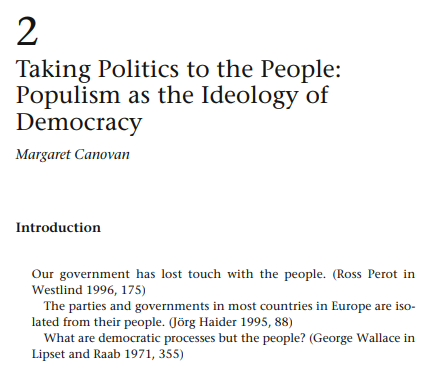
I drew much inspiration from classic works such as Margaret Canovan’s research on populism as an idea of democracy. Over time I began to connect it with broader perspectives on how anti-establishment ideas of democratic politics, including populism, can be used as part of political strategies, engaging with works by Susan Scarrow, Sean Hanley and Allan Sikk, Tim Haughton and Kevin Deegan Krause, or Linda Bos et al., among many others.
I have always enjoyed connecting the dots between different approaches rather than assuming that only one perspective can fully grasp how populism appears in politics. What I can also recommend is going beyond the literature strictly on populism. It is also worth looking at work that discusses broader changes in (party) politics in the last decades: including classics by Peter Mair, as well as newer work by, for example, Jane Green and Will Jennings or Helen Margetts et al.
2) In recent years, you have studied anti-establishment parties. While every populist party is against the establishment, not every anti-establishment party is necessarily populist. Regarding this: what do anti-establishment parties that are not populist look like? What ideologies motivate them? Can you give us some concrete examples?
With a few exceptions, most parties will claim to do politics for ‘the people’ (however defined). Yet, in practice, only a few anti-establishment parties will promise to achieve this goal primarily by committing themselves to what ‘the people’ think and want. Without pronounced appeals to volonté générale, we cannot describe a party as populist.
In fact, once we account for other ‘thin’ ideas on democratic politics beyond populism, many anti-establishment parties interestingly turn out to be quite elitist.
First, parties can promise to do ‘good politics’ through technocratic appeals to extra-political expertise. Parties such as the Czech ANO, the Polish Nowoczesna, to some extent the radical right AfD in Germany in 2013 or Movimento 5 Stelle in Italy in 2018 fall into this category. Second, anti-establishment parties can also – quite paradoxically – promise to revive a ‘true’ way of doing conventional politics. I describe such claims as appeals to political vocation.
Appeals to political vocation do not refer to the will of populist ‘ordinary people’ or to technocratic non-political expertise. Instead, they invoke supposedly ‘forsaken’ qualities and virtues of formal-representative elite politics. These promises may include, for example, replacing career politicians who live ‘off politics’ with those who live ‘for politics’; replacing politics of ‘professional parties’ driven by mere electoral interests with the only party guided by political calling, determination, or political will to act rather than just talk; replacing systemic grift with integral politicians; or ending political ‘chaos’ by decisive strong (man) political elites. Parties that have made ample use of political vocation claims in their campaigns include La Republique En Marche in France, the radical right FPÖ in Austria 2017, and the Spanish Podemos in 2019.

SpongeBob against the establishment.
3) You studied the social media campaigns of anti-establishment parties in eight European countries. From your analysis, it appears that anti-establishment parties remained at the same level of populism in the period 2010-2019. However, during the same period, traditional parties have become increasingly populist. How do you explain this result?
One of the reasons behind this ‘stability’ in anti-establishment parties is paradoxically their life cycle instability. Anti-establishment parties come and go. The most successful ones often ‘grow up’ and reduce their anti-establishment rhetoric. In some cases, they may even turn into ‘conventional parties’. When this happens, their space is usually filled by newer anti-establishment parties with increased levels of anti-establishment rhetoric.
The trend among conventional parties is indeed quite interesting. To broaden their electoral appeal, parties can try to enact qualities for which they may have less reputation. For example, populist parties are often perceived as lacking political competence. Vote-maximizing populist parties may therefore enact political credibility, skills and experience. Conventional parties, on the other hand, may attempt to accommodate different elements of populism. As those parties can only rarely extensively adopt populism as a whole (e.g. including anti-establishment rhetoric), this might explain why we do not find empirical evidence of a full ‘populist Zeitgeist’, but still observe that several parties increasingly use selected elements of populism (such as people-centrism).
4) Among other things, you find that the radical right does *not* obtain any electoral gain by using a populist rhetoric. Isn’t that surprising?
At first sight, it is surprising, but on closer inspection less so. Previous research has already suggested that radical right support is not straightforwardly driven by populist rhetoric or policies related to citizen involvement. A radical right party can mobilise different groups of nativist voters: more populist or more elitist. This is why it is important to consider several ‘thin’ ideas beyond just populism. Regardless of the extent of populism, radical right parties benefit rather from linking nativism to authoritarian political vocation messages, such as promises of strong politics as allegedly a more decisive and efficacious version of conventional politics. The common denominator here is not populism, but the promise of strong (man) nativist politics.
5) As you show in your study, anti-establishment parties need to be careful when crafting their message: if they are too critical of the status quo they might be perceived as pursuing unrealistic goals. However, if they are not critical enough, they risk being perceived as part of the elites. How do they navigate this trade-off, and what are the results?
It is important that parties can use anti-establishment rhetoric to varying degrees. This means that political parties can blur their anti-establishment profiles. This gradualist perspective highlights that parties can try to calibrate and balance their levels of anti-establishment rhetoric. This allows those parties not only to appeal to different voter groups but also to send signals to different types of party activists.

At the same time, a single party can also flexibly portray itself as both ‘normal’ and ‘distinct’ from current politics. In fact, most anti-establishment parties have portrayed themselves not as isolated niche challengers, but instead, as ‘true’ elites, for example those representing supposed ‘silent majorities’. Parties can also attempt to redefine mainstream values in line with their ideology without having to moderate their radical positions. Several radical right parties have tried to reinterpret values such as freedom of speech or women’s rights as nativist arguments. In fact, my study provides empirical evidence that radical right parties were more likely to increase their electoral appeal when they were able to pursue this mainstreaming strategy.
6) Speaking of anti-establishment parties, one that is particularly ‘noisy’ lately is Alternative for Germany (AfD). Contrary to what one could expect, AfD instead of moderating over time, became more radical. How did this happen, and what will be the ultimate consequences?
The story behind the AfD’s radicalization is long and complex. But it also presents us with an interesting puzzle. How did the party’s more fundamentalist factions manage to dominate the party despite initially having less formal power within the organisation? We argued that one important aspect of this development is intra-party competition: other nativist factions within the party used the rhetoric of the more fundamentalist faction against competitors for intra-party office, thus granting it increased “soft power” within the party.
In 2023 the party has seen a strong rise in the polls, and several regional and state elections will be held in 2024. Even if the AfD fails to secure power at the state level, its gains will pose a serious challenge to liberal democracy and pluralistic civil society in the country.
Experiences of other countries suggest that reactions of pluralist-democratic parties play a crucial role in averting this risk. Parties need to empower civil society – in terms of ideal support, legislative reinforcement and financial sustainability. It is also important for parties to actively strengthen the legitimacy of liberal democracy – regardless of the extent of its formal institutional consolidation. Most importantly, pluralist-democratic parties must support civil society by facing up not only to radical right parties, but also to radical right policies and rhetoric.

Dr. Bartek Pytlas holds a Habilitation (Higher Doctorate) in Political Science from LMU Munich. Bartek’s research focuses on comparative party politics, especially on how party strategies contest and impact pluralist representative democracies. He is the author of the award-winning monograph Radical Right Parties in Central and Eastern Europe (Routledge). His work on radical right, populist and anti-establishment party politics across Europe was published in journals such as West European Politics, Journal of Common Market Studies, Government and Opposition and Party Politics.

 POP
POP 